


UNESCO meeting recalls the situation in Crimea
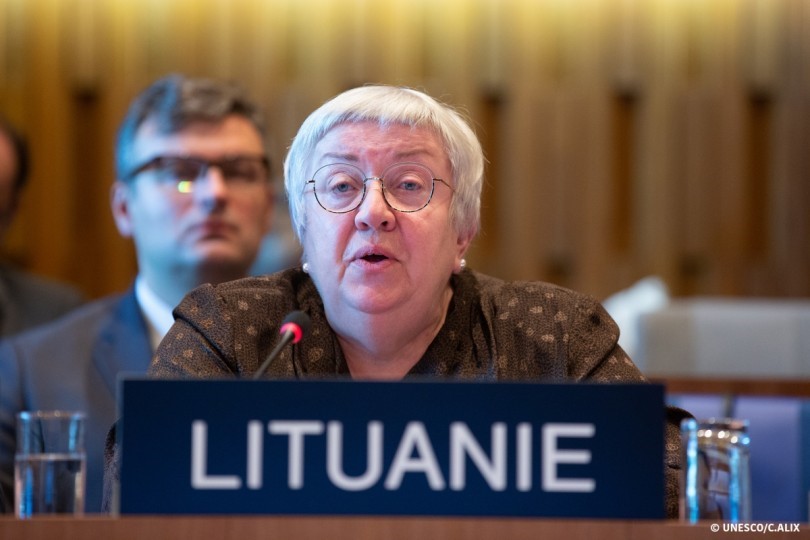
On 23 September, during an information meeting at UNESCO headquarters in Paris, the updated information on the situation in the Autonomous Republic of Crimea and the city of Sevastopol (Ukraine) within the fields of UNESCO’s competence was provided. Permanent Delegate of Lithuania to UNESCO, Ambassador Irena Vaišvilaitė, on behalf of 31 states, expressed the concern about the deteriorating situation in Crimea.
The Ambassador underscored that the member states who joined the statement support Ukraine’s territorial integrity within its internationally recognized borders, Ukraine‘s sovereignty and called on the Russian Federation to uphold all its obligations under international law. The statement notes that the co-signers do not recognise the holding of the“elections“ that were held by Russia on the Crimean peninsula on 8 September.
The incident that took place this summer, during the World Heritage Committee meeting, was also reminded. During this meeting the Russian Federation presented a publication that included distorted facts regarding the Ukrainian heritage in Crimea. “This attempt to manipulate information goes against UNESCO‘s principles“, noted The Permanent Delegate of Lithuania to UNESCO.
According to the statement, the constant deterioration of the situation caused by the Russian aggression on the illegally annexed Crimean peninsula causes deep concern which stems from the deterioration of media freedom, the safety of journalists and media workers, and access to religious institutions. The Ambassador also stressed the right of Crimean Tatars, Ukrainians and all ethnic and religious communities to maintain their language and culture, traditions, education and identity.
The statement stresses that Russia should immediately release all arbitrarily or unlawfully detained Ukrainian citizens which are still held in the illegally annexed Crimean Peninsula and Russia.
In 2014, UNESCO‘s Executive Board decided to follow up on the situation in Crimea, therefore the community of the organisation biannually assesses developments in this part of Ukraine in the fields of competence of UNESCO. The UNESCO Secretariat collects information on the situation in Crimea together with other cooperating organisations and consults with the Ukrainian authorities.
The member states who joined the statement on the situation in the Autonomous Republic of Crimea (Ukraine) are Albania, Andorra, Australia, Austria, Belgium, Bulgaria, Canada, Croatia, the Czech Republic, Denmark, Estonia, Finland, France, Georgia, Germany, Iceland, Ireland, Latvia, Lithuania, Luxembourg, Montenegro, the Netherlands, Norway, Poland, the Republic of Moldova, Romania, Slovenia, Spain, Sweden, Turkey, the United Kingdom of Great Britain and Northern Ireland.
Photo credit: Christelle Alix/UNESCO
